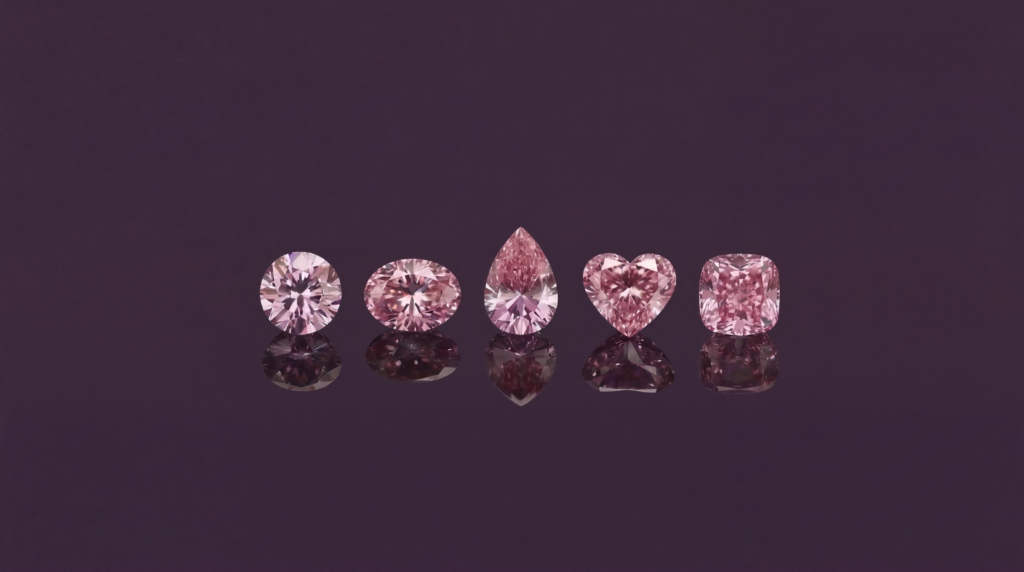
For over three decades, the Argyle Diamond Mine in Western Australia’s East Kimberley region was the source of more than 90% of the world’s pink diamonds. In November 2020, the mine closed permanently. No other source in the world is known to consistently produce diamonds of comparable colour or quality. What remains in circulation is all that will ever exist.
First excavated in 1983, the Argyle mine produced approximately 15 million carats of rough diamond annually at its peak — yet less than 1% of that output was pink. The mine’s remote Kimberley location, ancient geology, and unique conditions of heat and pressure are believed to be responsible for the extraordinary colour phenomenon that made Argyle stones world-famous.
The source of a pink diamond’s colour remains one of geology’s great mysteries. Unlike yellow or blue diamonds — where colour is explained by trace elements — pink diamonds owe their hue to a structural anomaly within the atomic lattice, formed under immense pressure deep within the Earth.

As of September 2025, Argyle’s final allocation and last-ever Tender have concluded. For the first time in 40 years, no new Argyle pink diamonds are entering the primary market. Wholesale access is now confined exclusively to existing first-generation inventory. Once absorbed, all certified Argyle pink diamonds will trade exclusively on the secondary market.
Argyle diamonds are graded on a proprietary colour scale developed by Rio Tinto — distinct from standard GIA grading. Colour intensity is the primary driver of value.
The signature Argyle colour and the most recognised of the collection. Graded from light pink through to vivid pink, these stones display a pure, warm hue that ranges from delicate blush to deeply saturated tones. Fancy Intense and Fancy Vivid grades represent the most sought-after end of the spectrum.
A rare secondary hue that emerges when violet undertones blend with the primary pink body colour. Pink purples occupy a distinct position in the Argyle grading scale, prized for their depth and complexity. Their unusual tone makes them particularly appealing to collectors seeking stones that sit outside the conventional pink range.
Characterised by a warm, rosy body colour with subtle secondary modifiers that give each stone a soft, luminous quality. Pink rose diamonds tend to carry a gentle saturation — less vivid than pure pinks, but no less rare. Their romantic, feminine tone has made them a consistent favourite among jewellers and private collectors alike.
The rarest colour grade in existence. Fewer than 35 stones have ever been presented with a red grade across the entire history of the Argyle Tender. Many remain unset, preserved as collectables and generational heirlooms. A true red Argyle is considered among the most extraordinary natural objects on earth.
The Argyle mine was the only known source of hydrogen-rich violet diamonds and its distinctive cornflower blue hues. Only a handful were ever offered at Tender across the mine’s operational lifetime, making authenticated blue and violet stones extraordinarily difficult to source on the secondary market.
Unlike equities or currency, certified Argyle pink diamonds are not subject to bank solvency or monetary policy. Their value is driven by documented scarcity, sustained global demand, and a finite, non-replenishable supply. As existing inventory is absorbed, market pricing is expected to reflect their increasingly rare status — making peer-to-peer access to this market particularly significant.
Rarearth provides a centralised secondary market for Argyle pink diamonds — the first of its kind for private buyers and sellers. Compare certified listings side by side, transact without auction house fees or retail markups, and access a national market of qualified buyers and investors from a single platform.
All Argyle pink diamonds listed on Rarearth must carry an original Argyle Diamond Identification and Provenance Certificate, issued by Rio Tinto, alongside supporting grading documentation from a recognised authority such as the GIA. Certification is verified prior to every transaction.